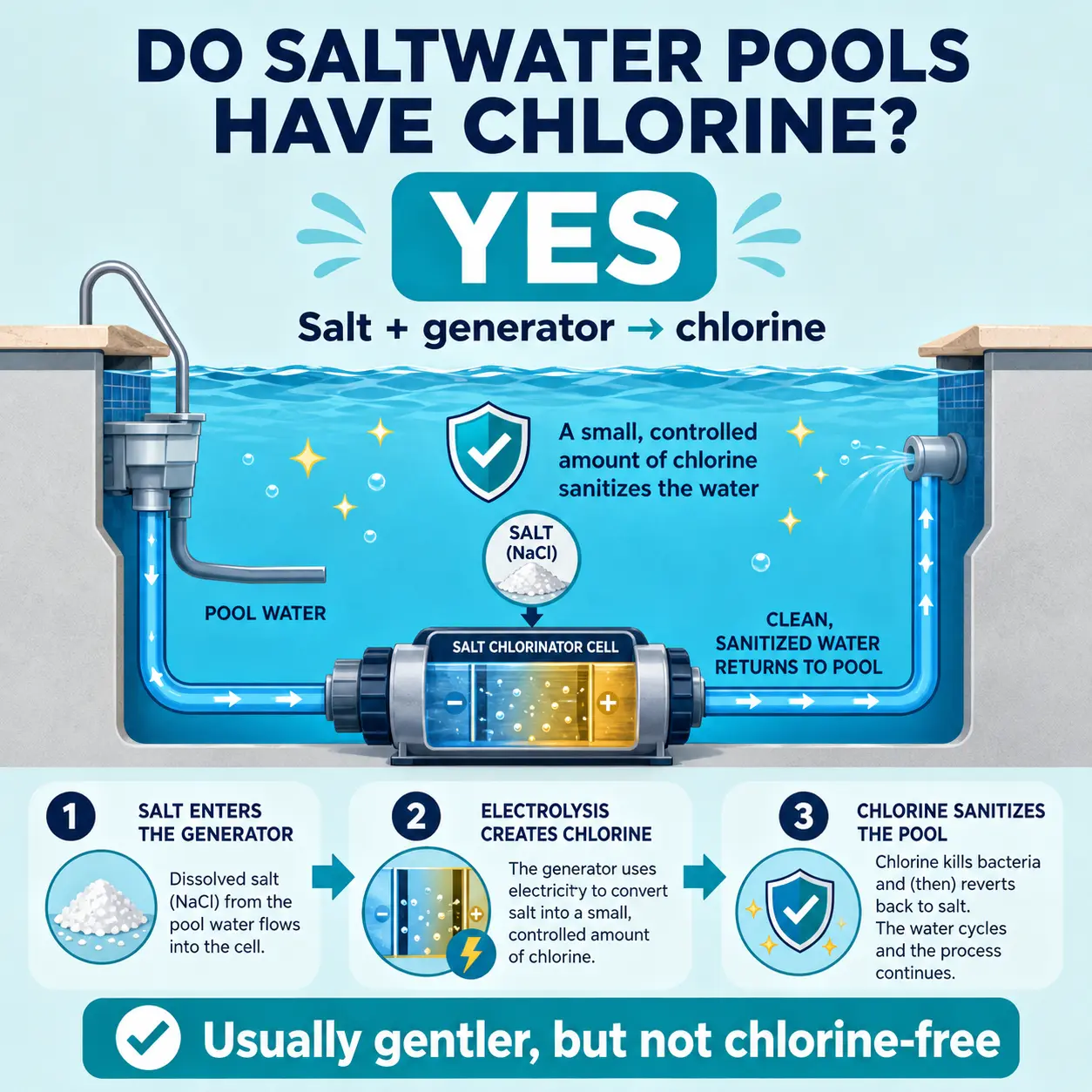
Yes, salt water pools have chlorine. In fact, chlorine is still the main sanitizer responsible for keeping the water clean and safe.
The difference is not the type of sanitizer being used. It is how that sanitizer gets into the pool. A traditional pool requires chlorine to be added directly as a liquid, tablet, powder, or granule. A salt water pool uses a salt chlorine generator to produce chlorine from dissolved salt.
This gradual production process can make the water feel softer and reduce sudden changes in chlorine levels. However, it does not make the pool chlorine-free.
Why Do People Think Salt Water Pools Are Chlorine-Free?
The term “salt water pool” can create the impression that salt replaces chlorine. In reality, the salt is a raw material that the pool equipment uses to make chlorine.
Many swimmers also notice that salt water pools have a less obvious chemical smell. The water may feel gentler on the skin, and some people experience less eye irritation. These differences can make it seem as though no chlorine is present.
A properly maintained salt pool still contains enough chlorine to control bacteria, algae, and other contaminants. Without that chlorine, salt alone would not keep the water sanitary.
How Does a Salt Water Pool Make Chlorine?
A salt water pool uses a device called a salt chlorine generator, salt chlorinator, or chlorine generator. The system is connected to the pool’s circulation plumbing and includes an electrolytic cell.
Here is how the process works.
Salt Is Dissolved in the Water
Pool-grade salt is added directly to the pool. Once it dissolves, the salt circulates with the water through the pump and filtration system.
The salt concentration in a typical residential pool is much lower than the concentration in ocean water. Although some swimmers may notice a mild salty taste, the water should not feel like seawater.
Water Passes Through the Salt Cell
After the water moves through the filter, it enters the salt cell. Inside the cell are specially coated metal plates connected to a low-voltage electrical supply.
Electrolysis Produces Chlorine
The control unit sends an electrical current through the saltwater. This process, known as electrolysis, converts chloride from the dissolved salt into active chlorine compounds.
The freshly produced chlorine then flows back into the swimming pool.
Chlorine Sanitizes the Pool
Once in the pool, chlorine attacks bacteria, algae, and organic contaminants. Sunlight, heat, swimmers, and debris gradually consume the available chlorine.
After completing the sanitation process, much of it eventually returns to chloride and can move through the system again. This repeating cycle allows the generator to provide chlorine without requiring frequent manual doses.
How Much Chlorine Is in a Salt Water Pool?
The correct chlorine level depends on the pool’s design, water temperature, stabilizer level, swimmer activity, and other conditions. A salt system should be adjusted according to accurate water-test results rather than guesswork.
Salt water pools often maintain chlorine more steadily because the generator produces small amounts over an extended period. Traditional pools may receive larger manual doses followed by a gradual decline.
This does not necessarily mean that every salt water pool contains less chlorine than every traditional pool. Both systems need an appropriate free chlorine level to keep the water sanitary. A neglected salt pool can have too little chlorine, while an incorrectly adjusted system can produce more than necessary.
The goal is not to achieve the lowest possible chlorine level. The goal is to maintain enough active chlorine for safe and comfortable swimming.
What Is Free Chlorine?
Free chlorine is the portion of chlorine available to sanitize the water. It has not yet reacted with contaminants.
This is one of the most important measurements in any swimming pool, including a salt water pool. If the free chlorine level falls too low, bacteria and algae may begin to grow. If it rises too high, swimmers may experience irritation and the water can become uncomfortable.
Regular testing helps confirm whether the generator is producing the correct amount.
What Are Combined Chlorine and Chloramines?
When chlorine reacts with sweat, body oils, urine, and other contaminants, it can form compounds called chloramines. These are often referred to as combined chlorine.
Chloramines can contribute to:
A strong chemical smell
Red or irritated eyes
Skin discomfort
Poor indoor air quality around enclosed pools
Reduced sanitation performance
The sharp smell associated with some swimming pools does not always mean there is too much useful chlorine. It can indicate that the chlorine has reacted with a heavy contaminant load.
Because a salt generator supplies chlorine gradually, a well-maintained salt pool may have fewer noticeable chloramine problems. Good filtration, balanced water, proper circulation, and swimmer hygiene also play important roles.
Does Salt Replace the Need for Chlorine?
Salt does not sanitize a swimming pool effectively on its own at the concentration used in residential salt systems.
Its main purpose is to supply the chloride that the generator converts into chlorine. If the generator stops working, the dissolved salt will remain in the water, but the pool will no longer receive its normal chlorine supply.
Chlorine levels can then fall, especially during hot weather or heavy pool use. This can allow cloudy water, bacteria, or algae to develop.
Do Salt Water Pools Need Added Chlorine?
Most of the time, a properly sized and correctly adjusted salt generator should handle routine chlorine production. However, there are situations when manually added chlorine may still be necessary.
After Heavy Pool Use
A large number of swimmers can introduce sweat, sunscreen, body oils, and other organic material. The generator may not be able to respond quickly enough to the sudden increase in chlorine demand.
Following Heavy Rain or a Storm
Rain can dilute pool chemicals, while storms may carry leaves, soil, dust, and other contaminants into the water. Additional chlorine may be needed to restore water quality.
During an Algae Problem
A generator is designed to maintain routine sanitation. It may produce chlorine too slowly to treat an established algae outbreak. A separate chlorine treatment may be required.
When the Generator Is Not Working
Low water flow, mineral buildup, electrical problems, cold water, low salt, or an aging cell can interrupt chlorine production. Manually adding chlorine can protect the pool while the equipment is inspected.
When Opening the Pool
A pool may need an initial chlorine treatment after remaining covered or unused for an extended period. The salt system can then take over once the water has been cleaned and balanced.
Do Salt Water Pools Need to Be Shocked?
A salt water pool may occasionally need shock treatment, but it should not be done automatically on a fixed schedule without considering the water condition.
Shocking involves raising the chlorine level to address problems such as algae, contamination, or excessive combined chlorine. Some salt generators have a high-output or boost mode, but this setting can place additional wear on the cell and may work too slowly for a serious problem.
Before shocking the pool, test the water and identify why treatment is necessary. Correcting the cause is just as important as temporarily increasing the chlorine.
Why Do Salt Water Pools Often Smell Less Like Chlorine?
The smell commonly associated with swimming pools usually comes from chloramines rather than from clean, properly balanced free chlorine.
A salt system releases chlorine steadily while the equipment is operating. This can help avoid the large peaks and drops sometimes associated with manual dosing. When sanitation, filtration, and circulation are working correctly, fewer odor-producing compounds may accumulate.
A salt water pool can still develop a strong smell if:
The chlorine level is too low
The pool has a heavy swimmer load
Water circulation is poor
The filter needs attention
The water chemistry is unbalanced
Organic contamination is present
A strong smell should be treated as a reason to test the water, not as proof that the pool contains too much chlorine.
Are Salt Water Pools Better for Skin and Eyes?
Some swimmers find salt water pools more comfortable because the chlorine is produced gradually and the water may feel softer. A properly balanced salt pool may also contain fewer irritating chloramines.
However, salt water does not guarantee irritation-free swimming. Discomfort can still occur when:
Chlorine is too high or too low
The pH is outside the proper range
Chloramines have accumulated
Salt concentration is excessive
A swimmer has sensitive skin or an existing condition
The pool contains contaminants
People who react badly to chlorine should understand that a salt pool still exposes them to chlorine. The reaction may feel less severe in a well-maintained pool, but individual experiences vary.
Can Chlorine in a Salt Pool Damage Hair or Swimwear?
Chlorine can affect hair color, dryness, and fabric over time, regardless of how it enters the pool. Salt may also contribute to dryness or leave residue if swimmers do not rinse afterward.
Swimmers can reduce these effects by:
Rinsing with fresh water before entering the pool
Wearing a swim cap
Rinsing hair, skin, and swimwear after swimming
Using hair products designed for swimmers
Keeping pool chemistry properly balanced
Avoiding swimming when chlorine is unusually high
Correct water balance is more important than whether the pool uses a salt generator or manually added chlorine.
Salt Water Pool vs. Traditional Chlorine Pool
Salt pools and traditional pools both use chlorine. Their main differences involve chlorine delivery, equipment, and routine maintenance.
| Feature | Salt Water Pool | Traditional Chlorine Pool |
|---|---|---|
| Main sanitizer | Chlorine | Chlorine |
| Chlorine source | Produced from dissolved salt | Added directly |
| Chlorine delivery | Gradual and automated | Usually added in separate doses |
| Chemical smell | Often less noticeable when balanced | Can be more noticeable if chloramines build up |
| Initial equipment cost | Higher | Lower |
| Routine chlorine handling | Usually less frequent | Usually more frequent |
| Specialized equipment | Salt generator and cell | No salt cell required |
| Maintenance | Testing, cleaning, cell care, and chemical adjustment | Testing, cleaning, dosing, and chemical adjustment |
Neither system is automatically cleaner than the other. Water quality depends on proper chlorine levels, filtration, circulation, cleaning, and chemical balance.
How to Check Chlorine in a Salt Water Pool
A salt generator’s display can provide useful information, but it should not replace direct water testing. Sensors may become inaccurate because of scale, temperature changes, electrical issues, or normal wear.
Use a reliable testing method to check free chlorine and combined chlorine. Testing should be more frequent during hot weather, periods of heavy use, and after major storms.
If the chlorine level is consistently low, possible causes include:
Low salt concentration
Insufficient pump operating time
A low generator output setting
A dirty or worn salt cell
Cold water
Poor circulation
Heavy organic contamination
Excessive sunlight and insufficient stabilizer
A generator that is too small for the pool
If chlorine is consistently high, reduce the output setting or pump operating time as appropriate. Continue testing until the level becomes stable.
Common Myths About Chlorine in Salt Water Pools
“Salt Water Pools Do Not Use Chemicals”
They still depend on chlorine and require chemicals to manage pH, alkalinity, calcium hardness, and other aspects of water balance.
“Salt Sanitizes the Pool by Itself”
At normal pool concentrations, dissolved salt does not replace an effective sanitizer. The generator must convert it into chlorine.
“A Salt Pool Can Never Smell Like Chlorine”
It can develop an odor if chloramines accumulate or the water is not properly maintained.
“Salt Pools Always Have Less Chlorine”
They may provide a steadier chlorine level, but the actual concentration depends on the system settings and water conditions.
“The Generator Eliminates All Maintenance”
The pool still needs testing, brushing, vacuuming, filtration, pH control, and cell inspection.
Frequently Asked Questions
Are salt water pools completely chlorine-free?
No. Salt water pools use a generator to make chlorine from dissolved salt. Chlorine remains the main sanitizer.
Can you swim safely in a salt water pool?
Yes, provided the water chemistry is balanced, the sanitizer level is appropriate, and the equipment is operating correctly.
Can a salt water pool work without a chlorine generator?
The pool can hold saltwater without the generator, but it will not receive the regular chlorine production needed for sanitation. Another sanitizer source would be required.
Why is there no chlorine reading in my salt water pool?
The generator may not be producing enough chlorine, or the chlorine may be consumed faster than it is produced. Check the salt level, cell condition, output setting, pump schedule, water temperature, and overall chemistry.
Does a salt water pool taste salty?
It may have a mild salty taste, but the concentration is much lower than seawater. An extremely salty taste may indicate that the salt level should be tested.
Is a salt water pool healthier than a chlorine pool?
Both systems use chlorine and can provide safe water when maintained correctly. Some swimmers find salt pools more comfortable, but comfort does not make them chlorine-free or automatically healthier.
Final Thoughts
Do salt water pools have chlorine? Yes. They use dissolved salt and an electrolytic cell to produce chlorine as the pool water circulates through the system.
The main advantage is controlled, gradual chlorine production. This can reduce routine chemical handling and help maintain a steadier sanitizer level. It may also create a more comfortable swimming experience when the water is properly balanced.
Still, a salt water pool requires regular testing and maintenance. Salt does not replace chlorine, and the chlorine generator does not replace responsible pool care. Understanding that distinction helps pool owners maintain cleaner water and avoid many of the problems caused by incorrect expectations.
Need to Add Salt to Your Pool?
Use our free calculator to find how many pounds or kilograms of pool-grade salt to add based on your pool volume and current salt reading.
Calculate Salt Needed →