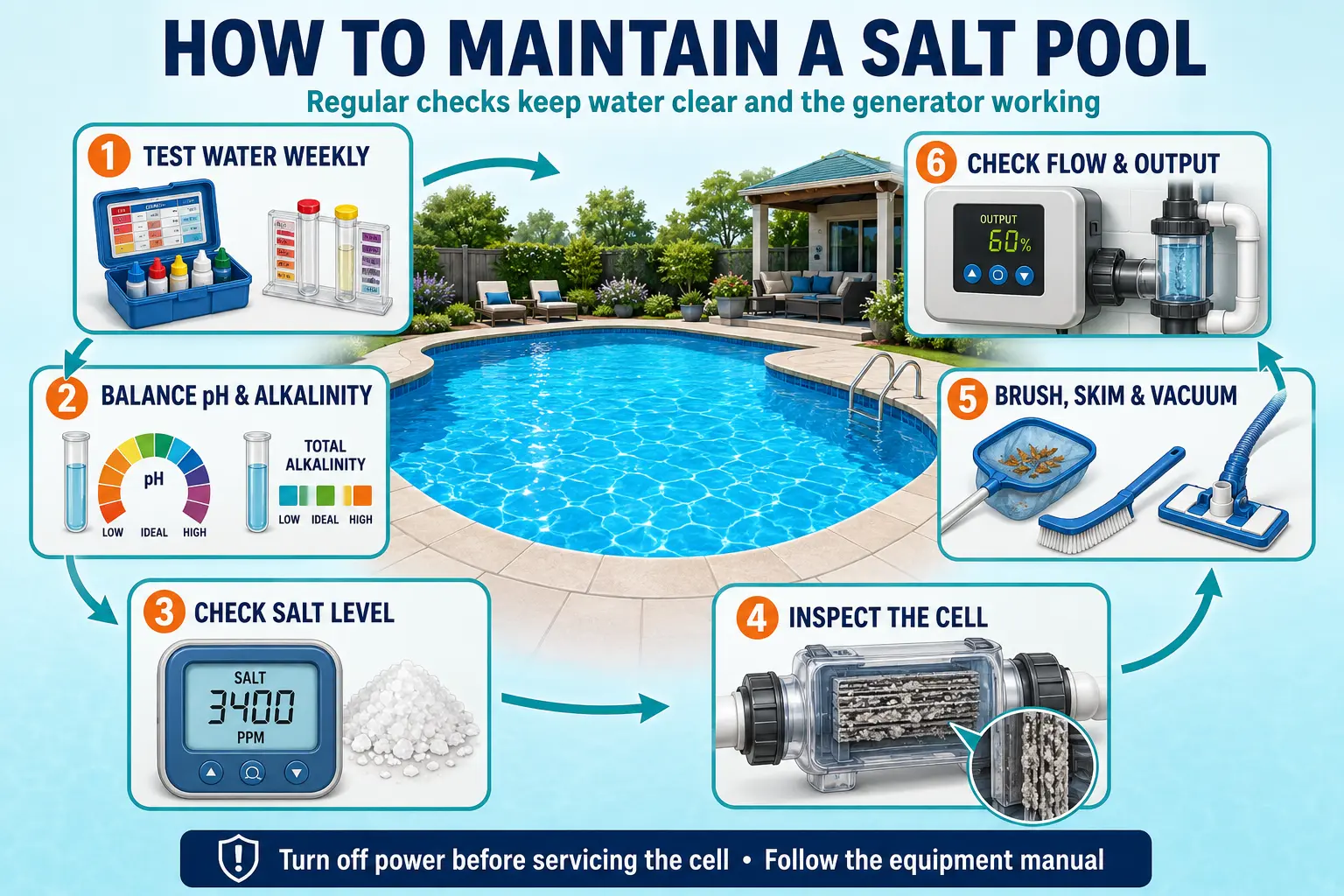
A salt water pool is often marketed as low-maintenance, but it still requires consistent care to stay safe and clear. The good news is that with a straightforward weekly, monthly, and seasonal routine, salt pool maintenance becomes predictable and manageable.
Understanding Your Salt System
Your salt chlorine generator converts dissolved salt into chlorine through electrolysis. It does this continuously while the pump runs, maintaining a steady low-level chlorine supply. However, the generator cannot correct pH, total alkalinity, calcium hardness, or cyanuric acid — those require your attention.
Target Water Chemistry Ranges
| Parameter | Target Range | Test Frequency |
|---|---|---|
| Free chlorine | 1–3 ppm | Weekly |
| pH | 7.2–7.6 | Weekly |
| Total alkalinity | 80–120 ppm | Monthly |
| Salt level | 2,700–3,600 ppm* | Monthly |
| Cyanuric acid (stabilizer) | 70–80 ppm | Monthly |
| Calcium hardness | 200–400 ppm | Monthly |
| Combined chlorine (chloramines) | <0.5 ppm | Weekly |
*Check your generator's manual for its specific recommended salt range.
Weekly Maintenance Tasks
1. Test the Water Chemistry
Use a reliable test kit, test strips, or a digital meter to check free chlorine, pH, and combined chlorine. If free chlorine is below 1 ppm or above 3 ppm, adjust the generator's output setting. If pH drifts above 7.6 — which is common in salt pools — add muriatic acid or dry acid to bring it down.
2. Skim and Brush
Remove debris from the surface with a skimmer net. Brush the pool walls, steps, and floor to prevent algae from taking hold. Salt systems do not prevent algae from attaching to surfaces — brushing does.
3. Empty Skimmer and Pump Baskets
Clogged baskets reduce water flow, which reduces the salt cell's effectiveness. Check and empty them at least once a week or after heavy debris from storms or wind.
4. Check Generator Status
Look at your control panel for any warnings: low salt, low flow, inspect cell, or high temperature. Address warnings promptly to avoid poor chlorine production.
Monthly Maintenance Tasks
5. Test Salt Level and Cyanuric Acid
Use a salt test strip, digital salt meter, or submit a water sample to a pool store. If salt is below the generator's minimum operating level, use our calculator to determine how much to add. Test cyanuric acid monthly — too little and UV degrades your chlorine rapidly; too much and chlorine becomes less effective.
6. Test Calcium Hardness and Total Alkalinity
High calcium can cause scale on the salt cell and pool surfaces. Low calcium can cause the water to etch plaster. Total alkalinity acts as a pH buffer — keep it at 80–120 ppm to prevent pH from swinging.
7. Inspect the Salt Cell Visually
Remove the cell from the plumbing and shine a light through it. Look for white or gray calcium deposits on the plates. Light scale is normal; heavy buildup needs cleaning.
Cleaning the Salt Cell (Every 3–6 Months)
- Turn off the pump and power to the cell.
- Remove the cell from the housing.
- Use a garden hose to rinse off loose debris.
- If calcium scale is present, prepare a cleaning solution of 1 part muriatic acid to 4 parts water (always add acid to water, not water to acid).
- Soak the cell in the solution for 10–15 minutes — no longer, as acid can damage the coating on older plates.
- Rinse thoroughly with fresh water before reinstalling.
- Never use a metal brush or scraper on the plates — only rinse or soak.
Some modern cells have a self-cleaning reverse-polarity feature that reduces scale. Even these should be inspected every 3 months during peak season.
Shocking the Pool
Even with continuous chlorine generation, you should superchlorinate in these situations:
- After heavy swimmer load (pool parties, holidays)
- After a significant rainstorm
- When you notice cloudy water or early algae (green tint)
- When combined chlorine (chloramines) exceeds 0.5 ppm
- After extended equipment downtime
Most salt systems include a boost or super-chlorinate mode — run it for 8–24 hours. For severe algae, add liquid chlorine or calcium hypochlorite directly and treat with an algaecide.
Seasonal Maintenance
Opening the Pool (Spring)
- Remove, clean, and store the winter cover properly
- Reinstall the salt cell if it was stored over winter
- Fill pool to the correct water level
- Run the pump and inspect for leaks
- Test all water chemistry and balance before starting the generator
- Shock with liquid chlorine before enabling salt chlorination
Closing the Pool (Autumn)
- Balance water chemistry thoroughly
- Add a winter algaecide dose
- Clean the salt cell
- Remove the salt cell and store it indoors — freezing temperatures can crack the cell housing
- Lower the water level to below the skimmer
- Blow out the lines and add antifreeze if needed (cold climates)
- Install a winter cover
Troubleshooting Common Problems
- "Low Salt" warning but salt level is correct: The sensor or cell may be dirty. Clean the cell and rinse the sensor.
- Green water despite normal chlorine reading: Check pH — if above 7.8, chlorine is nearly ineffective. Lower pH and shock the pool.
- Cell not producing chlorine: Check for scale buildup, low salt, low water temperature (cells produce less chlorine below 60°F), or a failing cell that needs replacement.
- Cloudy water: Usually a pH, alkalinity, or calcium hardness problem. Test and adjust all three.
- Rapid pH rise: Normal in salt pools. Add acid weekly or bi-weekly as needed; some owners install a CO₂ injection system for automatic pH control.
Need to Add Salt?
Use our free salt pool calculator to find out exactly how many pounds to add based on your pool volume and current salt level.
Calculate Now →