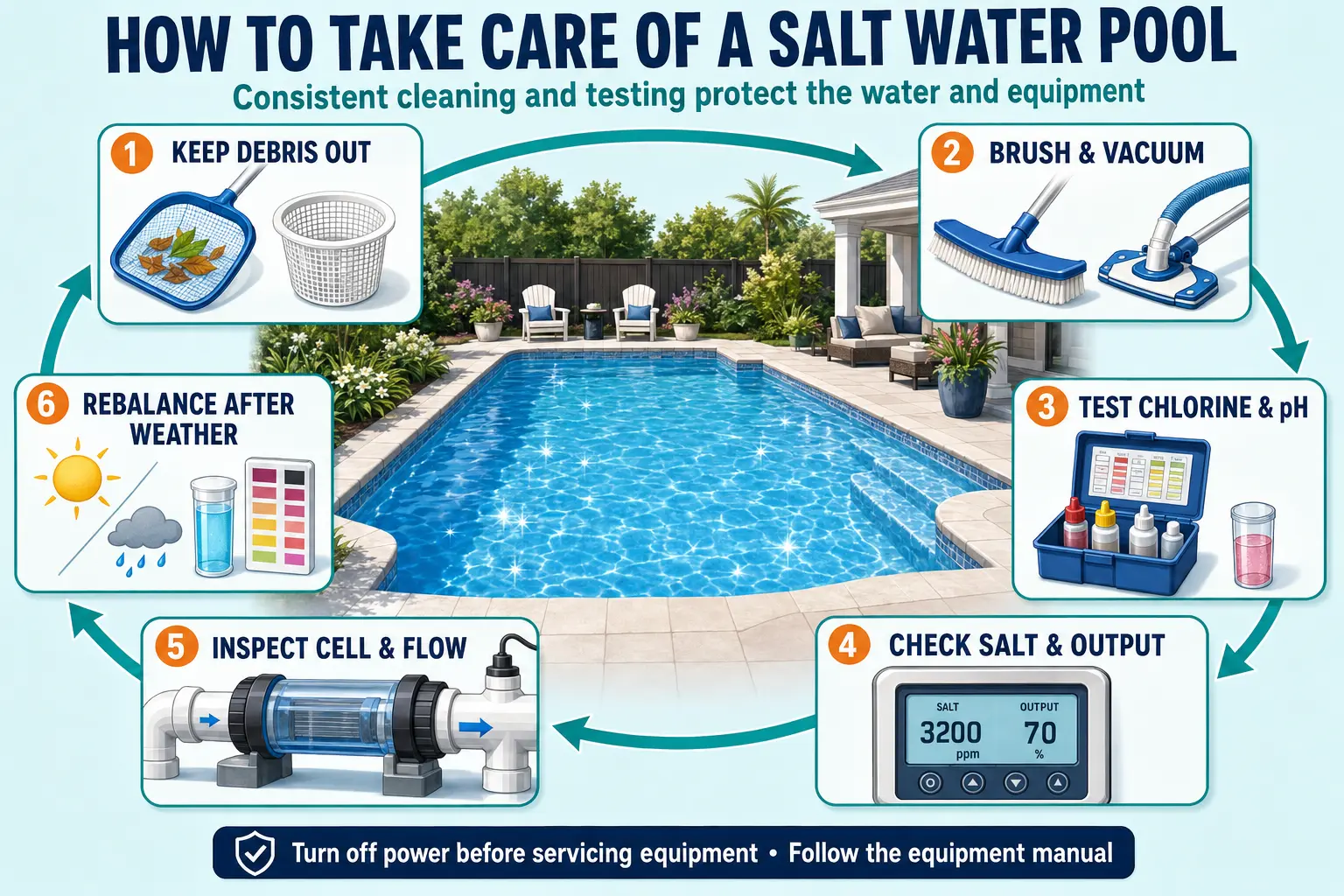
Salt water pools are popular for their softer feel and more automated chlorination — but "automated" does not mean "self-managing." A salt pool still needs regular attention to stay clear, balanced, and safe. This guide walks through exactly what to do and when.
What Makes Salt Pool Care Different?
The fundamental tasks — testing, balancing, brushing, cleaning the filter — are the same as any pool. What changes with a salt system:
- You test and manage the salt level (not just chlorine)
- You inspect and clean the salt cell every 3–6 months
- You manage a tendency for pH to creep upward — salt systems naturally raise pH
- You rely on the generator for routine chlorine, but still shock manually when needed
Daily Tasks
Skim the Surface
Leaves, insects, pollen, and other debris add organic load to the water and consume chlorine. Skimming daily reduces this burden and helps keep chlorine levels steady. A robotic pool cleaner or automatic skimmer can handle much of this automatically.
Check the Pump Is Running
The salt cell only produces chlorine when the pump is circulating water. If the pump stops unexpectedly, chlorine production halts too. A quick visual check of the system's normal operating sounds and indicator lights takes less than a minute.
Weekly Tasks
Test Water Chemistry
Use a test kit or digital meter to check:
| Parameter | Target | Action If Off |
|---|---|---|
| Free chlorine | 1–3 ppm | Adjust generator output up or down |
| pH | 7.2–7.6 | Add muriatic acid if high; add soda ash if low |
| Combined chlorine | <0.5 ppm | Shock the pool |
Brush Walls and Floor
Algae spores attach to pool surfaces before becoming visible. Weekly brushing disrupts these early colonies before they bloom. Pay extra attention to steps, corners, and behind ladders — low-flow areas where algae tends to start.
Empty Filter and Skimmer Baskets
Full baskets restrict water flow through the salt cell, reducing chlorine output. A quick check and clean takes under five minutes.
Check the Control Panel
Your generator's control unit will display warnings for low salt, low flow, inspect cell, or temperature issues. Check it as part of your weekly routine. Persistent warnings that don't clear after basic checks (cleaning the cell, confirming water level) may indicate equipment needing professional service.
Monthly Tasks
Test Salt Level
Salt doesn't get used up — but it does leave the pool through splash-out, backwashing, leaks, rainfall overflow, and draining. Test monthly with a salt test strip, digital meter, or water sample sent to a pool store. Use our calculator to determine how much salt to add if the level has dropped below your generator's minimum.
Test Total Alkalinity, Cyanuric Acid, and Calcium Hardness
- Total alkalinity (80–120 ppm): Acts as a pH buffer. Low alkalinity causes pH to swing wildly. High alkalinity makes pH hard to lower.
- Cyanuric acid (70–80 ppm): Stabilizes chlorine against UV degradation. Too much makes chlorine less effective. Top up with stabilizer granules; dilute with fresh water if too high.
- Calcium hardness (200–400 ppm): Low calcium causes water to etch plaster and equipment. High calcium causes scaling on the cell and pool surfaces.
Backwash the Filter
For sand or DE filters, backwash when the pressure gauge rises 8–10 psi above the clean starting pressure. For cartridge filters, remove and rinse the cartridge. A dirty filter restricts flow through the salt cell.
Salt Cell Care (Every 3–6 Months)
The electrolytic cell is the most important piece of equipment in a salt system. Calcium scale accumulates on the plates and reduces chlorine production efficiency. Left uncleaned, it can permanently damage the cell.
How to clean the cell:
- Power down the pump and generator
- Disconnect the cell from the plumbing unions
- Rinse with a garden hose at moderate pressure
- If scale is visible, mix a solution of 1 part muriatic acid to 4 parts water — always add acid to water, never the reverse
- Immerse the cell plates (not the connectors) for 10–15 minutes
- Rinse thoroughly with fresh water
- Reinstall and restart the system
Never use a metal tool or hard brush on the plates. The coating on modern cell plates is chemically active — scratching it shortens the cell's life.
How to Handle pH Creep
Salt water pools almost universally experience a slow rise in pH. This happens because the electrolysis process at the cell releases hydrogen gas, raising the water's pH over time. Left unchecked, high pH makes chlorine less effective and promotes scale on the cell.
- Check pH weekly
- Add muriatic acid (hydrochloric acid) or dry acid (sodium bisulfate) to lower pH — follow label directions for your pool volume
- Add a small amount and retest after 4 hours of circulation before adding more
- Some owners install a CO₂ injection system for automatic pH control — worth considering if pH management is a constant chore
When to Shock a Salt Pool
Use your generator's super-chlorinate or boost mode — or add liquid chlorine directly — when:
- The pool hosts a large gathering
- After heavy rainfall that dilutes the pool
- You see cloudy water, green tint, or algae starting
- Combined chlorine exceeds 0.5 ppm
- The pool has been closed for several days without running the pump
When to Call a Professional
- Your water stays cloudy despite correcting all chemistry parameters
- The salt cell is producing no chlorine and cleaning has not helped
- You notice significant corrosion on metal fittings, steps, or equipment
- Error codes appear on the control board that you cannot resolve with the manual
- Your pool has persistent algae despite repeated shocking and brushing
Need to Top Up Your Salt Level?
Use our free calculator to find exactly how many pounds of salt to add based on your pool's size and current salt reading.
Use the Calculator →